The risk for violence is the use of physical force with deliberate intent to injure other persons or destroy property. Many people associate people who use violence with aggression which is angry or violent behavior. However, a person who is aggressive will not necessarily act violently. If you need of an effective and reliable Risk for violence Care Plan, Nursing writing services offers you the best quality Risk for violence Care Plan Writing Services. Nursing Writing Services has been in the industry for a long time providing students and nurses from different parts of the world with Risk for violence Care Plan Writing Services.
Risk for violence Care Plan Diagnosis
The risk of violence hinders a person from reasoning or managing emotions in a manner sociable to others. A diagnosis is essential to ascertain the likely cause for a person to aggressive and plan a care plan that includes actions and interventions that can solve the reasons.
The typical indicators of risk for violence are:
Distrust for almost everyone
Tendency of violent reactions
Mind delusions
Aggressive action and tendency to destroy objects in surrounding objects
Self-destructive behavior
Panic
Perceiving environment as a threat
Irritability and restlessness
Anger towards "messenger" of specific information including nonhuman media
Risk for violence Care Plan Goals and Outcomes
Violence endangers the life and health of a patient. A care plan should, therefore, have ways of stemming the problems fast. When deciding on a care plan, a nurse should enable the patient to achieve these outcomes:
Stop engaging in acts that might cause injury to self, other people and anything in the environment
Recognize the signs of increased anxiety
Discuss the suitable interventions
Start trusting other people around them
A caregiver should help to reduce and maintain stress to a level that does not cause aggression in a patient and orient him or her to reality.
Risk for violence Care Plan Assessment
Assessment is essential in helping a caregiver to determine what makes patients aggressive. By identifying the cause, it becomes simpler to think of the best methods of intervention. These assessments are essential in identifying the reason why a patient is at risk for violence.
History of violent victimization: A patient who has bitterness about past victimizations may act violently to retaliate and revenge the mistreatment.
History of early aggressive behavior:A patient with a history of aggression is likely to maintain the trend and assume it is normal.
Low IQ: Low IQ could be hindering the patient from valid reasoning with other people and result to aggression.
Poor behavior control: Patients with poor behavioral control may not know consider violence to be a vice.
Abuse of drugs or alcohol: Substance and alcohol abuse cause impairment in judgment.
Emotional distress: A person with much misery is anxious and irrational thus are likely to react violently at slight provocation.
Risk for violence Care Plan Interventions
A care plan for, the risk of violence should have interventions that help to reduce the aggression and treat the causes in the long term. These interventions are the way for a caregiver to help a patient who is violent.
Create an environment with low stimulus levels
A violent patient should spend time in a quiet place, lighting, and simple decor. Anxiety levels increase in a stimulus laden environment. A quiet setting prevents the patient from perceiving the people and anything around as a threat that becomes agitated.
Observe the patient's behavior every 15 minutes
Close observation is essential as it helps the nurse to make timely interventions upon noticing behavioral changes. A nurse should disguise it as a routine activity to prevent the patient from becoming suspicious.
Remove objects that might harm the patient or environment around
Removing items that a patient might use to cause harm ensure there is safety for the patient and another people including you.
Try to substitute destructive behavior with something positive
Physical exercises and anxiety-reducing activities such as hitting sandbags is a safe way of eliminating the latent tensions.
Ensure the patient takes medication according to prescription
Help and sees to it at the patient takes medications and observes directions by the physician. Monitoring the effectiveness of drugs and any side effects is also essential.
When the patient shows signs of recovery, a caregiver should find intervention from counselors, support groups and family to help the patient in solving the social and emotional factor that case risk for violence.
Risk for violence Care Plan Writing Services
A Risk for violence Care Plan should present The process and set of action associated with medical care for Risk for violence condition. Due to limited time, involvement to other activities, inadequate knowledge in complex topics or resources, Nurses and Nursing Students may have to rely on Risk for violence Care Plan Writing Services providers. Nursing Writing Services has the best writers with experience in writing and training in medical field dedicated in ensuring we offer you the best Risk for violence Care Plan Writing Services for a reliable Risk for violence Care Plan.
Risk for seizures Care Plan Writing Help Online are care plans about behavioral changes or physical findings due to uncontrolled electrical discharges or firing from the nerve cells of cerebral cortex. Sudden brief attacks with altered consciousness, sensory phenomena, and motor activity. Lead poisoning, injuries, infectious illnesses, fevers, brain tumors and underdevelopment are the major cause of seizures. Nursing Writing Services has the best Risk for seizures Care Plan Writing Help Online
A seizure is a term that medical practitioners use interchangeably with convulsion. Motor symptoms of seizure arise from frontal lobe while sensory symptoms are from the parietal lobe.
Risk for seizures Care Plan Diagnosis
The risk for seizures diagnosis should be more about checking for conditions that could increase the risk or cause seizures. A nurse should define whether there is the existence of these conditions:
Ineffective tissue perfusion related to seizure
Ineffective coping relates to epilepsy consequences
Risk of injury relating to seizure activity
Weak breathing pattern related to the postictal period indicated by abnormal respiratory rhythm, rate, and depth.
Inefficient breathing pattern due to neuromuscular impairment due to prolonged tonic phase of seizure
Risk for seizures Care Plan Goals and outcomes
Goals to help a patient in achieving results that lead to control of risk factors should make up the care plan to help the patient in improving quality of life. The risk of seizures care plan should help in the achievement of these goals and outcomes.
Identify potential risk factors and correct them
Help the patient to verbalize factors contributing to possibility of suffocation or trauma and take necessary remedies
Regular breathing pattern enough to meet the body oxygen needs
Regular breathing pattern enough to meet the body oxygen needs
Modify environment to enhance safety
Recognize the crucial needs for assistance that will prevent injuries
Risk for seizures Care Plan Assessment
An assessment by a nurse on patient helps to view the patient holistically and determine the real needs of a patient. These assessments help a caregiver to identify likely causes of increased risk for seizure and prepare a care plan that contributes to their controlling, reducing and elimination with time.
Seizure history and circumstances before an attack
Description of movement during seizure and point where stiffness usually starts
Duration of each attack
Position of the head and the patient's eyes including size of pupils
Presence of automatisms such as repeated swallowing or lips smacking
Incontinence
Presence of unconsciousness during seizure and estimate duration
Behavior after attack including an inability speak, sleep a paralysis or weakness.
Compliance with any medication
History of alcohol or drug abuse
Risk for seizures Care Plan Intervention and Rationales
After diagnosis and assessment, a care plan should have appropriate interventions to manage the seizures.
Help the patient to take safety precaution
Seizures usually happen without warning and taking precautionary measure could be late if there were no advance measures. These include setting up suction equipment, padding on side rails and ambu-bag nearby.
Maintain the airway
A seizure hinders the patient from maintaining the airway or handling oral secretions. It is a good reason to set up suction.
Gather essential data for reference to a physician
A nurse should gather information on precipitating factors that happen before a seizure, specific timing and location then forward it to a specialist who can use the details to make appropriate clinical decisions.
Administer antiepileptics medication as per prescription
Patients who encounter seizures are likely to be on antiepileptic medications that a caregiver should ensure they receive prompt and take them when necessary such as when seizures last longer than 2 minutes. A nurse should also monitor other medications and call for a reevaluation of any medicine that causes or increases the times that a patient encounters seizures.
Provide emotional support
Seizures cause confusion and panic. Offering support and empathy to a patient is important.
When attending to a patient with high risk for seizure, a nurse should teach family, colleagues, and friends who spend much time around the person about the essential actions to take if they notice that it is about to occur.
Risk for seizures Care Plan Writing Help Online
Have you just realized that your Risk for seizures Care Plan is due tomorrow morning? That is fine! Get some sleep, and let the best Nursing Care Plans Writing Services offer you custom Risk for seizures Care Plan Writing Help Online.
Intracranial refers to something relating to the skull. Decreased Intracranial Adaptive Capacity Care Plan Writing Services is about a condition that causes a compromise to the intracranial fluid dynamic that usually compensates an increase in intracranial volumes. It results in a disproportionate increase in intracranial pressure as a response to various noxious and non-noxious stimuli. Nursing Writing Services has the required capacity to offer the best Decreased Intracranial Adaptive Capacity Care Plan Writing Services
It is essential for a nurse to carefully check defining characteristics that confirm that a patient is suffering from decreased intracranial adaptive capacity and not another relating condition. The signs and symptoms point to its presence.
Disproportionate increase in the ICP after a single maneuver
Baseline ICP of 10mmHg
Elevation of P2 ICP waveform
Volume-pressure ration of more than 2
Wide amplitude ICP waveform
Repeated increase of 10 mm Hg lasting more than after external stimuli
Other factors relating to decreased intracranial adaptive capacity are:
Brain injuries
Sustained hypotension with- a. Sustained increased ICP b. Decreases cerebral perfusion intracranial hypertension
Decreased Intracranial Adaptive Capacity Care Plan Goals and outcomes
A good care plan will have the result in mind. A nurse should work to help a patient in realizing these outcomes at the end of therapy:
Maintain a steady and efficient breathing pattern
Maintain normal ABG levels
Show no signs of fever
Maintain regular bodily functions
Develop an environment to eliminate the noxious stimuli
Maintain skin integrity
Stay free of any infections
Show no signs of neurological disorders
Medical and care giving teams also have goals to attain after diagnosis and treatment.
Fluid balance
Balanced Electrolyte and Acid-Base
Total consciousness
Fast wound healing
Decreased Intracranial Adaptive Capacity Care Plan Assessment
Decreased intracranial adaptive capacity will require attention by a specialist nut a nurse should be able to perform these assessments to have a clear picture of the likely cause of patient complaints but assessing these vital signs:
Temperature
Pulse
Heart rate and sounds
Electrocardiogram
Response to pain
Response to light
Respiratory rate, patterns, and depth
Distension of jugular vein
History of hypertension
It is also necessary to perform an assessment and monitoring of the following:
Pulse
ICP waveforms over time for determining trends
Assessment of cerebral perfusion pressure
All the information a nurse obtains independently or in collaboration with other health care professionals is essential in the identification of the most appropriate interventions.
Decreased Intracranial Adaptive Capacity Care Plan Interventions and rationales
Maintain any ICP monitoring systems in use
It is essential; to pay attention to ensure that the systems function right for the provision of accurate information.
Prevent infection
A nurse should see to it that the dressing changes or other forms of care take place and use a sterile technique to prevent contamination.
Maintain patent airway and suction when needed
Suction stimulates coughing as well Valsalva maneuver which in turn increases intrathoracic pressure. The three actions decrease cerebral venous drainage, increase cerebral blood volume which in turn results to increases ICP efficiently sorting the problem of decrease.
Position the patient in the appropriate position
Patients with decreased intracranial adaptive capacity need to have their head in 15-30 degrees or as per physician's orders. A nurse has to elevate the head. It may also require the use of rolled towels, sandbags or small pillows to help in maintaining the head in a neutral position.
Provide a calming environment
A nurse should provide calming conditions and reassure the patient. Prevent the patient from engaging in upsetting topics to prevent an emotional upset and increase ICP. Encourage the patient and those around him to discuss treatment and recovery positively. Expressions of positive feelings help the patient to cope better with treatment.
Before the patient leaves the hospital, inform the family on the appropriate care and refer the patient to support groups that help in dealing with recovery. A caregiver should if possible follow up the progress of the patient personally or through other forms of communication.
Decreased Intracranial Adaptive Capacity Care Plan Writing Services
We have hired professional nursing care plan writers with vast experience in working with students from around the world to guarantee the best Decreased Intracranial Adaptive Capacity Care Plan Writing Services
Impaired home Maintenance Care Plan Writing Help is about the inability to maintain and promote the safe, immediate environment independently. Nursing Writing Services offers the best Impaired home Maintenance Care Plan Writing Help online.
I Many factors lead to ineffective home maintenance. Lack of financial resources, knowledge on proper health practices and adaptive behaviors on changing environment are some examples of the reasons for poor home maintenance. Related factors such as illness, injury or deficit in knowledge are also contributors to an inability by a person clean maintain and repair a home for self/family comfort.
Despite the many factors, a nursing care plan is essential in developing interventions that efficiently addresses the aspects of a client needs. It also standardizes terms and allows nurses to quickly and safely attend to the patients.
Impaired Home Maintenance Care Plan Diagnosis
These signs and symptoms are essential in helping a nurse to determine if the client is suffering from impaired home maintenance or it is another condition.
Difficulties in maintaining a home with comfortable environment
Disorderly Surroundings
Dirty cooking equipment, linens, and clothes
Unavailability of essential items
Offensive odors
Presence of rodents
Inappropriate household temperature
Debts and other forms of financial crisis
Accumulation of dirt, hygienic or food wastes
Poor judgmental ability
A client who shows signs of imparted home maintenance is also likely to have these relating signs:
Deficient knowledge
Impaired functioning
Existence of disease
Inadequate support systems
Impaired home Maintenance Care Plan Goals and outcomes
Care plan to help a client in recovering from impaired home maintenance should enable the caregiver to reveal the problem and the patient accept about its existence by reacting in these ways:
Accept to have a problem of poor home maintenance
Expresses a need to change
Verbalizes plans to correct the safety and health hazards at home
Identify possible personal, family or community resources for fixing and maintaining excellent condition of the home.
Encourage the patient and family to start performing some daily activities including cleaning without fail.
Impaired home Maintenance Care Plan Assessments
Assess the home environment: It is essential that the caregiver determines the home environment of the client to determine the possible causes. Whether it is communication patterns, lack of knowledge about person care or lack of financial resources, identifying the reasons assists to in determination of appropriate intervention.
List obstacles hindering proper home maintenance: List obstacles with the patient and family help them to know the health and other risks that come with failure to keep their dwelling place in proper
Impaired home Maintenance Care Plan Interventions
A successful care plan should include practical interventions that help the patient to recover from the impaired home maintenance and improve the home to the safe and clean environment it deserves. These are helpful interventions for the patient.
Discuss solution with the patient at comfort level
Explain and convince the client about the specific needs for home improvements and the necessity to fulfill them. Provide reference materials on environmental and safety aspects of home maintenance.
Help the patient in choosing daily and weekly activities
Whether a patient stays alone or with family, a schedule helps to promote consistency in home maintenance. Encourage weekly discussions about the progress of home maintenance schedule to address any emerging problems before they overwhelm.
Provide options
Teach various home care skills. Teaching multiple skills helps the patient to choose the ones that suit his preferences or schedule.
Assist the patient to develop relaxation techniques
Some individuals or family might be failing to attend to their homes due to fatigue. It is essential to help in developing a program for relaxation strategies such as meditation, yoga and physical exercises. They help to reduce anxiety and re-energize the person to perform home maintenance.
A nurse who notices that a patient’s family is underprivileged or have other serious issues should find ways of linking them to community agencies such as self-help groups to assist them with cleaning and improving home management.
Impaired home Maintenance Care Plan Writing Help
From the nursing writing services reviews on Reddit and Quora, you will find Nursing Writing Services leading the pack as the best Impaired home Maintenance Care Plan Writing Help when it comes to reliability.
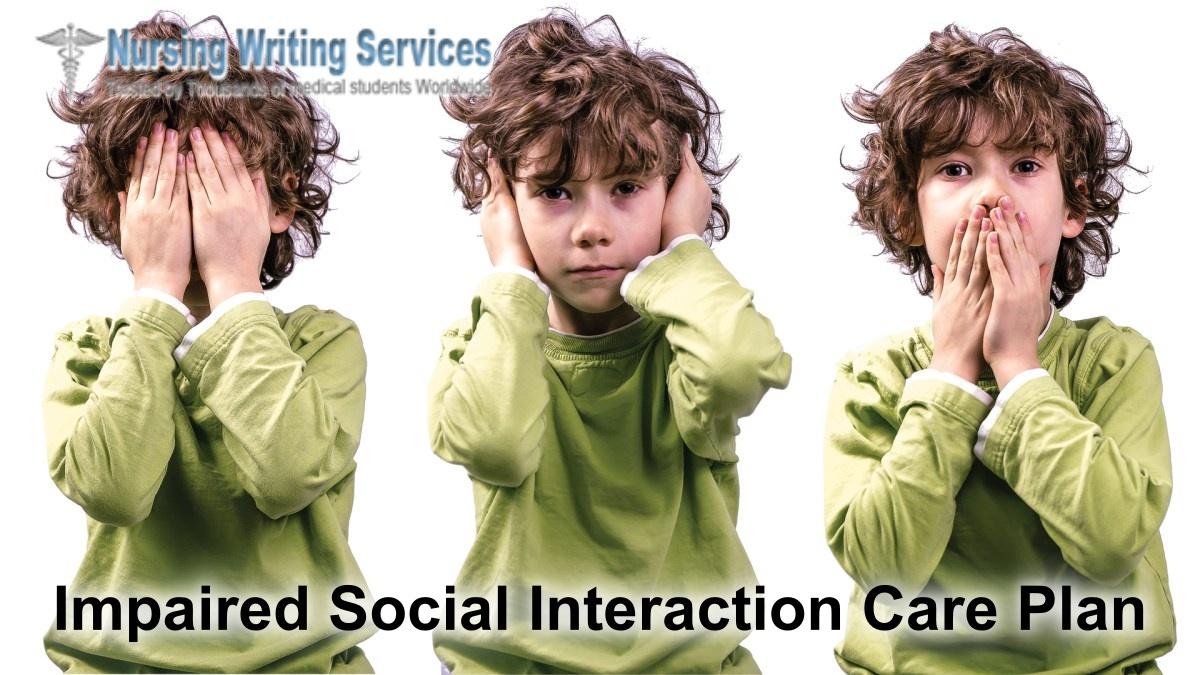
Impaired social interaction is a consistent lack of orientation to a person, place, circumstances or time for a period exceeding 3 to 6 months creating the necessity to form a protective environment. Protecting the patient is a professional judgment based on the application of clinical knowledge that determines the actual or potential experience of a patient. It also requires professional judgment to determine the response by a patient to this impairment and life processes it affects. Impaired Social Interaction Care Plan outiline the various set oction carried out when managing this condition. For the best, reliable and effective Impaired Social Interaction Care Plan, Nursing Writing Services offers you the best Impaired Social Interaction Care Plan Writing Services.
An impaired social interaction care plan helps the nurse to follow the commonly applied interventions and choose the most applicable to a patient. Choosing the intervention from a standard Impaired Social Interaction Care Plan allows fast, efficient understanding of the patient needs, the ways to sort them out and promote patient safety.
Impaired social interaction Diagnosis
A diagnosis is essential in finding out if a patient has impaired social interaction, particular need and the right course of action without going through a long narrative. After suspecting patient to have impaired social interaction, a caregiver should look if a patient has these signs and symptoms to confirm the existence.
Persistent state of disorientation to the environment
Extreme confusion
Inability to follow simple instructions, concentrate or reason
Memory decline that leads to loss of social function or occupation
Slow response to questions
A patient with these relating factors could also be having impaired social interaction.
Depression
Dementia
Huntington's disease
Impaired social interaction Care Plan Goals and Outcomes
A nurse should prepare a Impaired Social Interaction Care Plan with a goal to help the patient in achieving these outcomes that contribute to containing impaired social interaction:
Identify physical changes without taking offence
Acknowledge and respond to the efforts by other people in establishing communication
Maintain full extent orientation to the environment
Nursing assessment is essential to determine the defining factors showing that a patient must be having impaired social interaction. It also helps to define the right interventions to include in the Impaired Social Interaction Care Plan and help the patient to overcome the impairments.
A nurse should make these assessments:
Coordination and interaction with other people in the social settings
Hearing or vision deficits
Knowledge and communication
Sensory perception
Impaired Social Interaction Interventions and Rationales
A care plan should have nursing interventions based on outcomes of assessment to help the patient in achieving the desired results.
Orient patient to reality
Impaired social interaction causes disorientation of the mental functioning. Orienting a patient to the reality requires the nurse to keep calling the person by name, informing him about the day, date, year and location. Try to keep all items in the same place and ensure that the patient's name or photograph for them to register in the mind.
Observe the patient reaction to treatment
A nurse should give much attention to the client. The patient might be sensitive to the attitude of the people towards him or interventions. Having regular discussions inspires confidence in the caregiver encouraging the patient to share any unpleasant experiences. When talking to a patient, maintain eye contact to foster trust.
Instill coping mechanisms
A nurse can play an essential role in helping the patient to develop coping skills. One of the ways is to encourage the patient to perform activities of daily living (ADL) independently. When the patient gains the ability to complete most of them without assistance, it reduces the feeling of dependence. Another way is to focus on the patient's strengths. A nurse can, for example, praise the patient for completing task increases self-esteem and inspiration to try more in the coming days.
Encourage engagement in physical and social activities.
One of the interventions is to help the patient in conquering the sense of isolation by engaging in social activities with people of various age groups at least once in a week. Exercising also helps to improve the state of mind and allow the patient to have something different from the routine. A long-term intervention includes enrolling the patient in a support group.
For smooth implementation and success of interventions in an impaired social interaction care plan, a nurse should work together with the family of the patient and other healthcare professionals who treat the patient. Inform the family members or other caregivers about the essential reorientation techniques and assistance with self-care.
Impaired Social Interaction Care Plan Writing Services
Writing a perfect Impaired Social Interaction Care Plan can be challenging to understand on how to go about it. Nursing students, and professionals are often restrained by time and inadequate access to resources, Impaired Social Interaction Care Plan Writing Services come in handy to help. Nursing Writing Services has the best writers to handle Impaired Social Interaction Care Plan Writing Services and provide you the best and effective care plan. Our writers are well experienced and skilled in Nursing Care Plans Writing Services and have worked with different groups of nurses and students backed with training in medical and nursing sciences. This makes us stand out as the leading Impaired Social Interaction Care Plan Writing Services provider.
Developing an Effective Care Plan for Impaired Social Interaction
Introduction
Impaired social interaction is a challenging condition that can significantly affect an individual's ability to communicate, interact, and engage with others. This condition can arise due to various factors, such as developmental disorders, mental health issues, or neurological conditions. As healthcare professionals, it is crucial to develop comprehensive care plans that address the specific needs of patients with impaired social interaction. In this article, we will explore the essential components of an effective care plan for individuals facing difficulties in social interaction.
Assessment and Diagnosis
The first step in creating a care plan for impaired social interaction is a thorough assessment and diagnosis. Healthcare providers, including nurses, psychologists, and psychiatrists, must gather comprehensive information about the patient's medical history, social background, and behavioral patterns. Observation and standardized assessments can help in identifying the extent of impairment and the underlying causes.
Goal Setting
Once the assessment is complete, the healthcare team can establish specific and measurable goals for the patient's care plan. The goals should be individualized, focusing on improving the patient's social skills, enhancing communication, and fostering meaningful connections with others. Realistic and achievable objectives will guide the care plan's implementation and evaluation process.
Intervention Strategies
A successful care plan relies on the implementation of effective intervention strategies. These strategies should be evidence-based and tailored to the individual's unique needs. Some common intervention techniques include:
Social Skills Training: Conducting structured sessions to teach and reinforce appropriate social behaviors and communication skills. Role-playing and real-life scenarios can be utilized to practice interactions in a safe environment.
Group Therapy: Encouraging patients to participate in group therapy sessions can provide opportunities to practice social skills, build self-confidence, and gain insights from peers facing similar challenges.
Communication Aids: For patients with communication difficulties, using visual aids, assistive devices, or communication boards can facilitate expression and understanding.
Behavioral Therapy: Implementing behavior modification techniques to address specific social challenges and encourage positive behaviors.
Family Involvement: Involving family members in the care plan can promote consistency in supporting the patient's social development and integration.
Sensory Integration Therapy: For patients with sensory processing issues, this therapy can help regulate sensory responses, improving their ability to engage in social interactions.
Progress Monitoring and Evaluation
Regular monitoring and evaluation are vital components of an impaired social interaction care plan. The healthcare team should assess the patient's progress toward the established goals and make any necessary adjustments to the intervention strategies. Objective measurements and feedback from the patient, family, and caregivers can provide valuable insights into the effectiveness of the care plan.
Collaboration and Multidisciplinary Approach
Caring for individuals with impaired social interaction requires a multidisciplinary approach. Collaboration among healthcare professionals, educators, therapists, and family members is essential to ensure a holistic and well-rounded care plan. Regular team meetings can facilitate information exchange and provide a comprehensive understanding of the patient's progress.
Patient and Family Education
Educating the patient and their family about the condition and the care plan is crucial for its successful implementation. By understanding the challenges and strategies involved, the patient and their support network can actively participate in the care process, leading to more positive outcomes.
Conclusion
Developing an effective care plan for impaired social interaction is a collaborative and dynamic process. It requires a thorough assessment, goal setting, evidence-based interventions, and ongoing evaluation. With the right support and intervention strategies, individuals with impaired social interaction can make significant progress in their ability to communicate, interact, and connect with others, leading to improved overall well-being and quality of life. As healthcare professionals, it is our responsibility to provide compassionate care and help these individuals overcome their challenges to lead fulfilling lives.
NursingWritingServices.com is a reputable online platform that provides top-notch nursing writing services to students and professionals in the healthcare industry. The website is dedicated to offering high-quality academic and professional writing services to meet the unique needs of individuals seeking nursing-related help.